The AI Innovation Center, located at High Tech Campus Eindhoven, is the Netherlands’ leading AI hub, providing the right ecosystem of companies, experts, and facilities to help start and scale next-gen AI companies.
To overview
Building reliable AI agents with Snowflake: key takeaways and resources
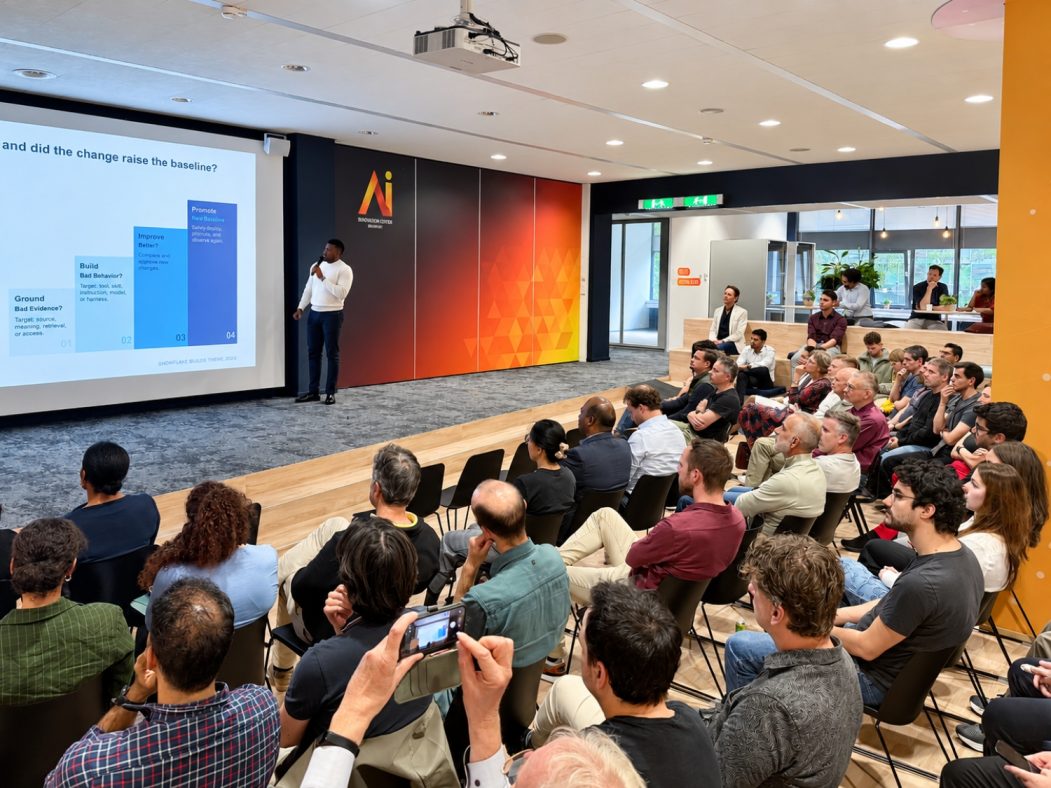
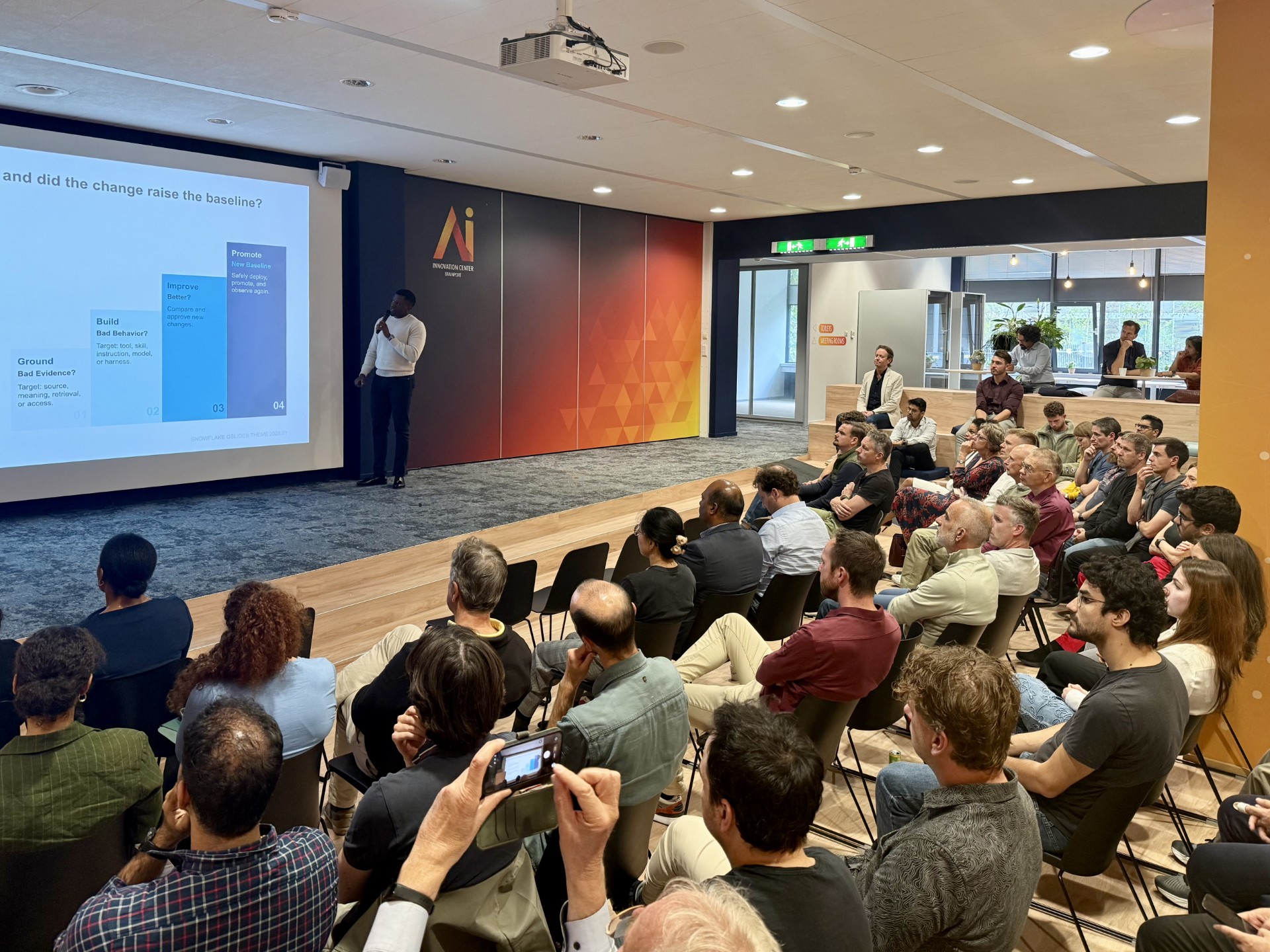
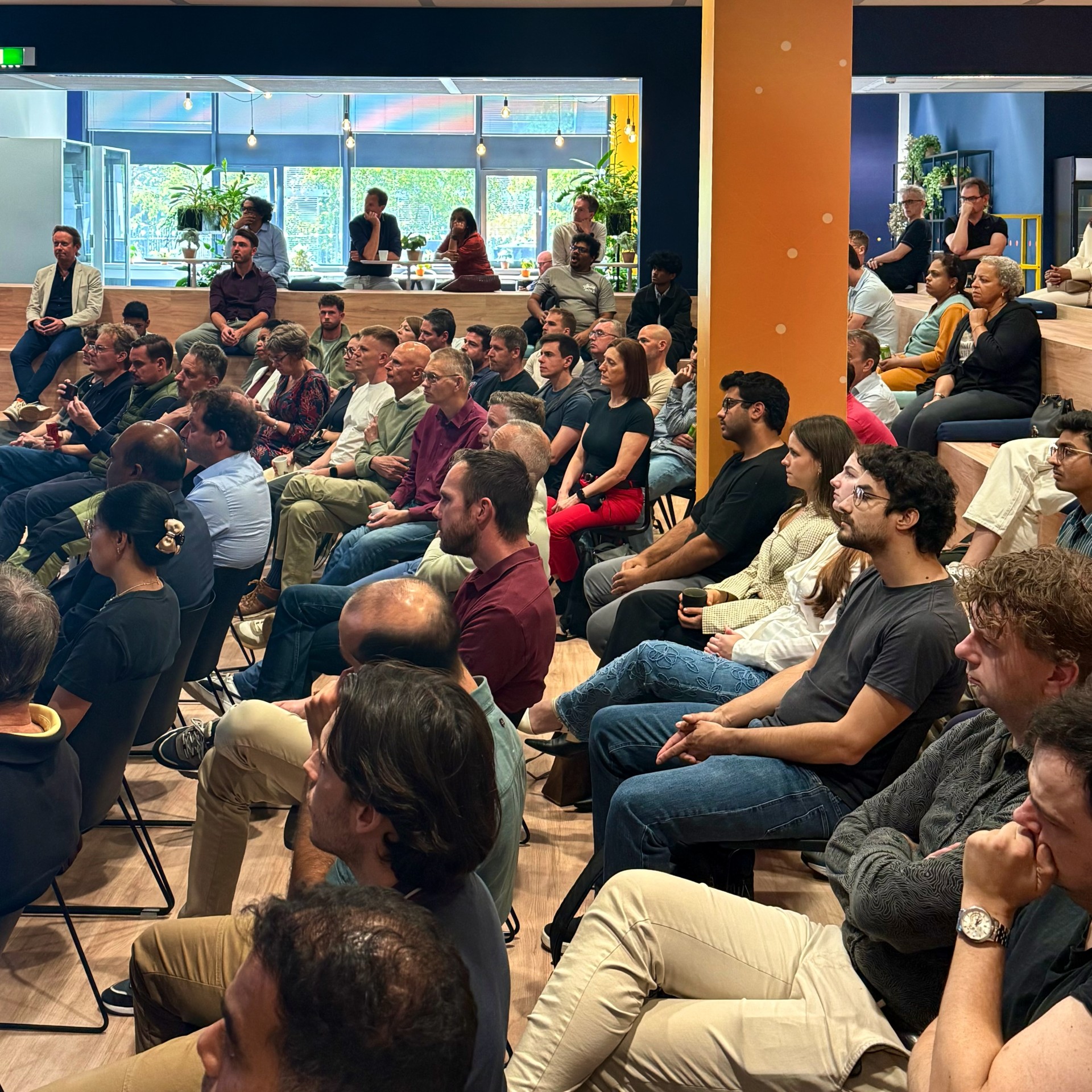
On September 10, the AI Innovation Center welcomed Jaïro Martha, Solution Engineer at Snowflake, for the latest edition of the quarterly AI Meet-Up. The event focused on a question that is becoming increasingly important for enterprise AI: how do you make AI agents reliable enough for everyday work?
Jaïro explored how to make AI systems useful and reliable in practice, using GROUND → BUILD → VALIDATE → IMPROVE to structure the work. The lifecycle covers preparing the right evidence, deciding how the work should run, validating the results and using what you learn to continuously improve the system.
Here are three key takeaways from the session.
1. Know what happened
When an AI agent produces a wrong answer, teams need to understand how it got there.
Traces can reveal the evidence an agent used and the tools it called during an individual run, while evaluations help determine whether its behavior and outcomes are acceptable across representative cases. Controls enforce the boundaries that need to hold regardless of the model’s response, including permissions, limits and approvals.
This gives teams something concrete to work with, rather than changing the prompt and hoping for the best.
2. Keep working the lifecycle
GROUND → BUILD → VALIDATE → IMPROVE gives the work structure. Get the evidence ready, choose how the task should run, test the complete outcome and use what you learn to improve it.
When something fails, traces can help locate the cause before choosing a fix. An incorrect answer, for example, could be caused by the evidence the system used rather than its instructions or model behavior. The diagnosis determines what needs to change.
Changes should then be compared with the current version using the same test cases, checking whether the original problem was solved without introducing regressions elsewhere. Quality, latency and cost all matter when deciding whether to promote a change.
And that work continues after launch. Data, users and business processes keep changing, so building something sustainable means someone needs to own its ongoing quality and operating costs.

3. Make it useful
Start with a problem that matters to someone, a clear owner and a way to recognize success. Then choose the simplest design that can do the job.
If you already know the steps, a workflow with AI in selected steps may be enough. An agent becomes relevant when the model genuinely needs to choose its next action based on intermediate results, within enforced limits.
The same thinking applies when choosing where to start. Identify real business problems and consider their business value and immediate feasibility before choosing a product or deciding how much autonomy to give the system. The aim is something people will use and the team can support.
Download the practical guide
Want to dive deeper? Jaïro created a three-page practical guide to the enterprise AI lifecycle to accompany his talk.
Beyond the AI Buzzwords: A practical guide to the enterprise AI lifecycle covers GROUND → BUILD → VALIDATE → IMPROVE in more detail, including choosing how the work should run, what happens inside an agent loop, validating system behavior and improving it over time.
Recommended reading
Jaïro also shared a selection of resources for anyone who wants to explore the topics from the session in more detail:
What’s Your Agent’s GPA? A Framework for Evaluating AI Agent Reliability – Snowflake
This gets into something discussed during the session: looking beyond the final answer to understand how the agent got there. It covers evaluating goals, planning and tool use so you can identify where things went wrong and what to improve.
Auditing AI Agents in Snowflake, Part 1: Foundation Queries – Michael van Meurer
How to inspect agent behavior through traces and audit logs.
Auditing AI Agents in Snowflake, Part 2: LLM-as-a-Judge Evaluation Pipelines – Michael van Meurer
A practical approach to evaluating response quality over time.
Building Effective Agents – Anthropic
A useful read on choosing between workflows and agents, and keeping the design as simple as the job allows.
Upcoming AI events
A big thank you to Jaïro Martha for sharing his expertise with the AI Innovation Center community, and to everyone who joined the session. Follow the AI Innovation Center on LinkedIn to stay up to date on upcoming events.